What Is Lampworking? The Oil Lamp Behind the Name
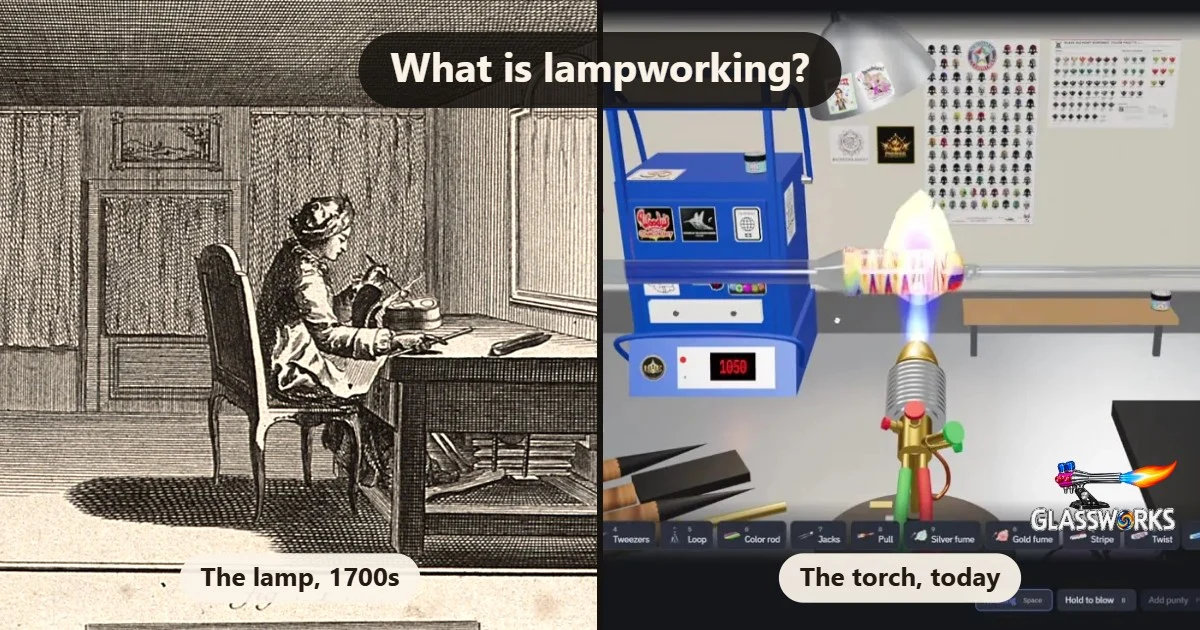
Then and now. Left: an 18th-century lampworker at his oil lamp (Wellcome Collection, public domain). Right: the bench in Glassworks.
What is lampworking? It is the craft of shaping glass rods and tubes in a small, focused flame, working at a bench instead of a furnace. It is called lampworking because, for centuries, that flame came from an oil lamp, made hot enough to melt glass by a bellows the worker pumped with one foot. Today the lamp is a gas and oxygen torch, but the name never changed.
Here is where the word comes from, what lampworkers built with nothing but a lamp, and how the same craft works at a modern torch.
What is lampworking, exactly?
The Corning Museum of Glass defines it simply: a flame softens glass rods and tubes, and the maker shapes them. You will also hear it called flameworking or torchworking. All three names mean the same thing.
That makes it different from furnace glassblowing, the kind with a glowing furnace and a long blowpipe. A furnace glassblower gathers a blob of molten glass out of a pot. A lampworker starts with solid glass, heats only the part they need, and builds the piece up a little at a time. Beads, marbles, pendants, figurines, lab glass and pipes are all lampwork.
The lamp, the bellows and the foot pedal
An oil lamp on its own is a lazy flame. To melt glass, early lampworkers forced air into it. The museum's definition describes an oil or paraffin lamp paired with foot-powered bellows: the worker sat at a table, pumped air with a foot, and aimed the hot, narrow flame at the glass with both hands free.
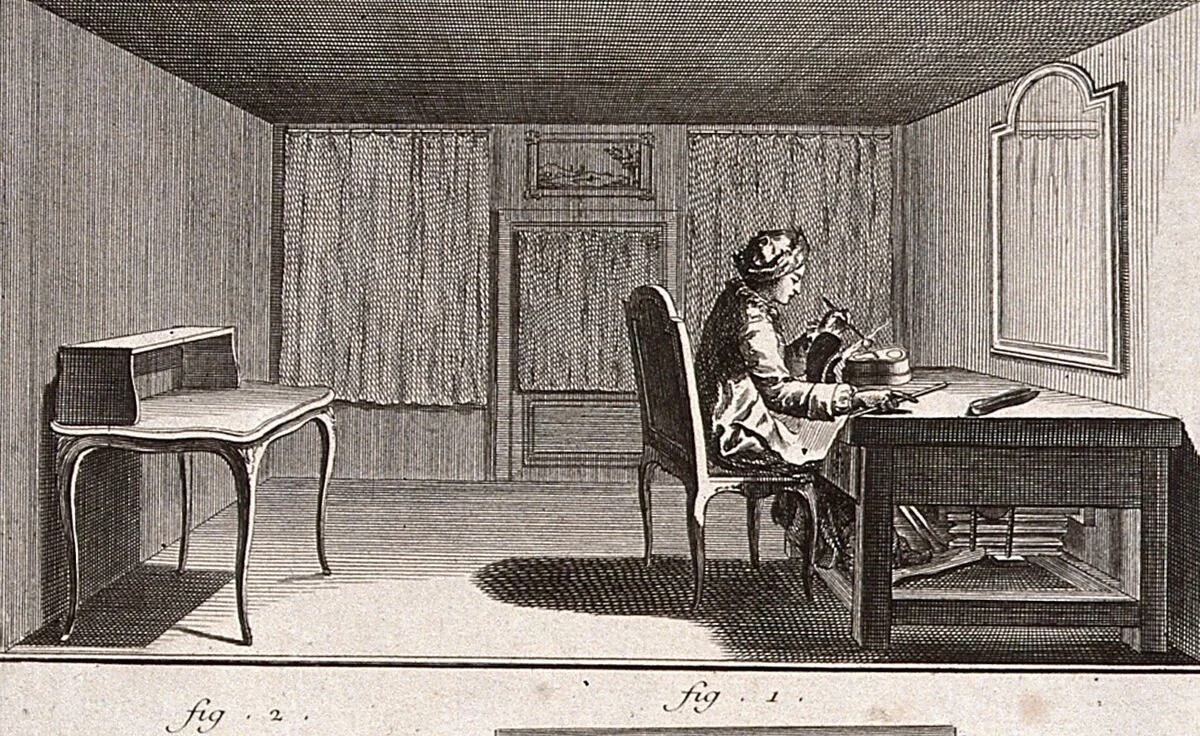
An enameller working at his lamp and pumping the bellows with his foot. Engraving by Defehrt after L.J. Goussier. Wellcome Collection, public domain.
One of the oldest pictures of the setup is in a 1679 glassmaking book, Ars vitraria experimentalis, published with a supplement by the German chemist Johannes Kunckel. Its single illustration of the trade shows a glassblower's table set with lamps, simple bellows and tiny finished pieces, according to the Corning Museum's library guide.
Notice the word in the engraving's title: the French called this worker an émailleur à la lampe, an "enameller at the lamp." Colored glass was the enamel. The French town of Nevers, which became famous for lampwork, also made the colored glasses its lampworkers needed.
What lampworkers made with a lamp
A lamp sounds like a weak tool. The work says otherwise.
A tiny head from about 2,500 years ago
The Corning Museum of Glass has a pendant shaped like a man's head, only about 3 cm tall, possibly made in Carthage around 400 to 500 BCE. Its stacked-dot eyes, added nose and lips, and wound beads in the headdress suggest a small, focused flame, as the museum explains. Researchers still debate how much ancient work was really done at a lamp, so think of it as a hint, not proof.
Venetian beads wound on a turning wire
On Murano, beads made a lume (at the lamp) date to the 1600s. A rod of glass was heated over the flame, and the molten glass was wound onto a metal wire that the worker kept turning, as the Murano Glass Museum describes it. When Murano hit hard times in the 1800s, beadmaking was the one part of the industry that kept growing.
Glass people, and a mechanical glass theater
In 1565, Henrietta of Cleves married the Duke of Nevers, and the Duke brought Italian glassworkers, lampworkers included, to his French town. From the mid-1500s to the end of the 1700s, Nevers and other French workshops turned out glass figurines: folk characters, saints, kings and whole nativity scenes. They were built over a skeleton of iron wire, with very thin copper wire hidden inside the glass. Nobody is sure why the copper is there. One theory says it held cracked glass together; another says it carried heat away so parts did not crack as they cooled.
The showpiece at Corning is a mechanical glass theater from about 1725 to 1775, more than two feet wide, filled with lampworked figures.
4,300 glass plants for Harvard
The most famous lampwork ever made is a classroom tool. Harvard professor George Lincoln Goodale wanted lifelike plant models for teaching botany, because the only options were crude papier-mâché and wax. A father and son in Germany, Leopold and Rudolf Blaschka, took the job. From the late 1880s to 1936 they made about 4,300 glass models covering 780 species, according to the Harvard Museum of Natural History. They are still on display, and they still fool the eye.
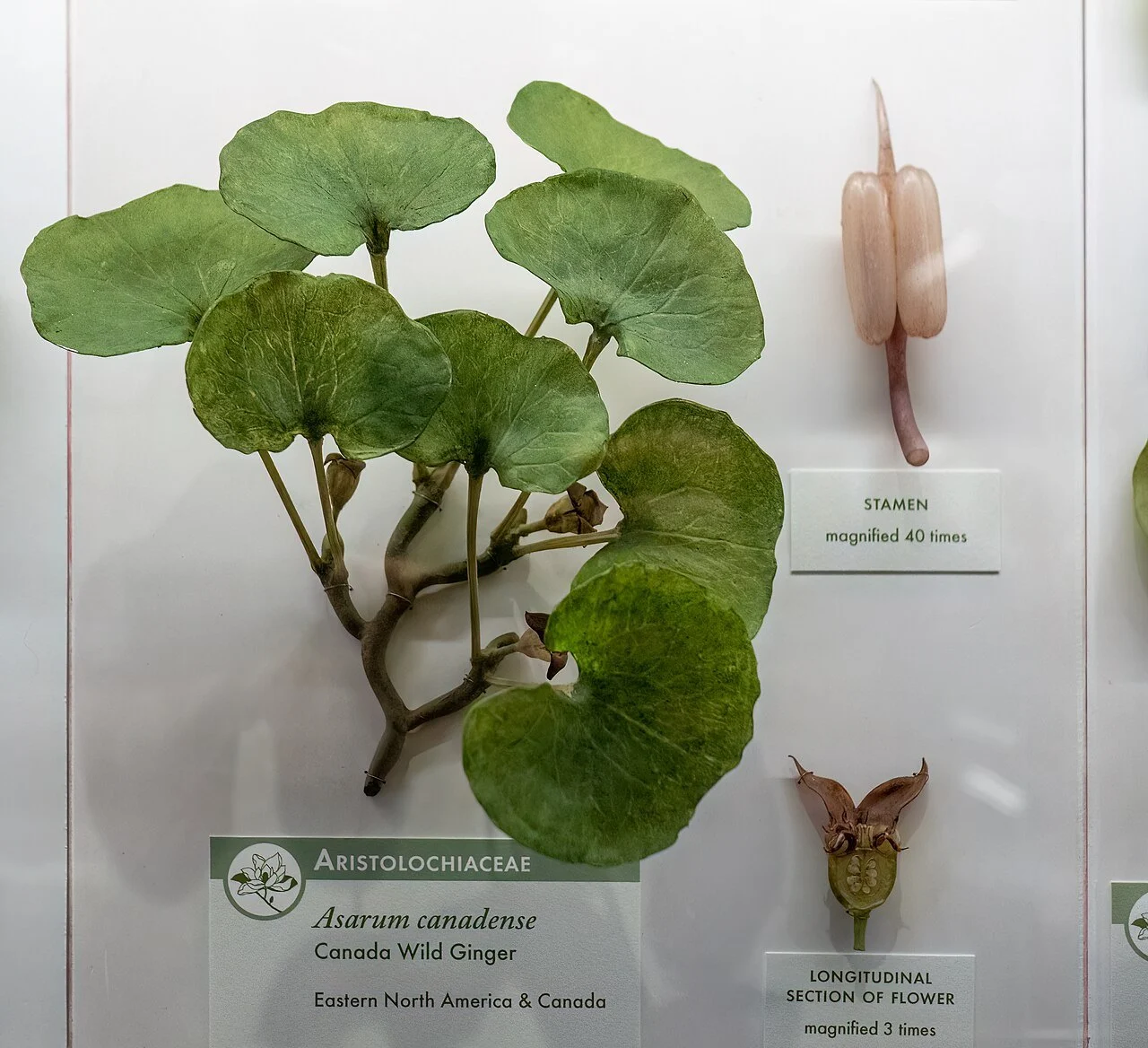
A Blaschka glass model of Canada wild ginger, with magnified flower parts. Photo: Rhododendrites, CC BY-SA 4.0, via Wikimedia Commons.
From oil lamp to oxygen torch
The lamp did not vanish overnight. In 1788, a German encyclopedia was still describing improvements to it. Gas is what changed everything. By 1886, a London manual by William Shenstone was already teaching glassblowing in the "oxy-gas flame," and laboratory glassblowing grew up around that hotter, cleaner fire.
Hot oxygen flames also made it practical to work borosilicate, the tough, low-expansion glass used for lab ware. Boro has a COE of 33, meaning it expands far less with heat than soft glass (Italian soft glass sits around 104), so it handles the temperature swings of torch work well. It needs a hotter flame to move.
Then boro went from the lab to art. Bob Snodgrass began lampworking in 1971 and is credited with color-changing glass made by fuming boro with silver and gold. After he started following the Grateful Dead on tour in 1987, his work spread fast. A few years later, in 1993, beadmakers founded the Society of Glass Beadmakers at an exhibit in Prescott, Arizona. It became the International Society of Glass Beadmakers in 2003.
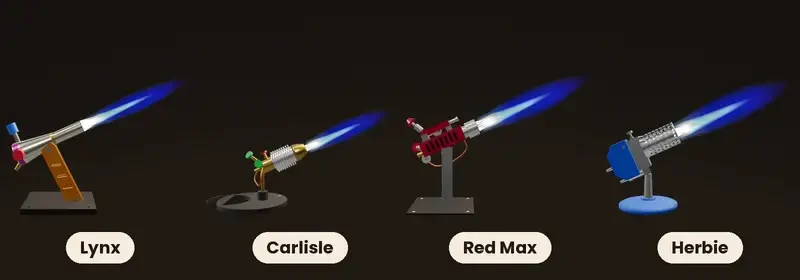
The four torches at the Glassworks bench. Modern torches like these burn fuel gas mixed with oxygen, a long way from a lamp and a foot pedal.
Lampworking vs. glassblowing vs. flameworking
Lampworking: the original name, from the oil lamp. Rods and tubes, worked at a bench.
Flameworking or torchworking: the same craft, named for the modern torch.
Furnace glassblowing: molten glass gathered from a furnace on a blowpipe, usually for larger pieces.
Scientific glassblowing: lampworking for labs, usually in clear borosilicate tubing.
Try it yourself: lampworking in Glassworks
You don't need a torch, a bellows or a foot pedal to see how this works. Glassworks is a borosilicate lampworking game that runs in your browser on desktop or phone. You sit at a bench at one of four torches, pull rods from the stock rack or pick tubing from 25 to 50mm, and shape the glass with the same tools a lampworker reaches for: marver, paddle, jacks, tweezers and more.
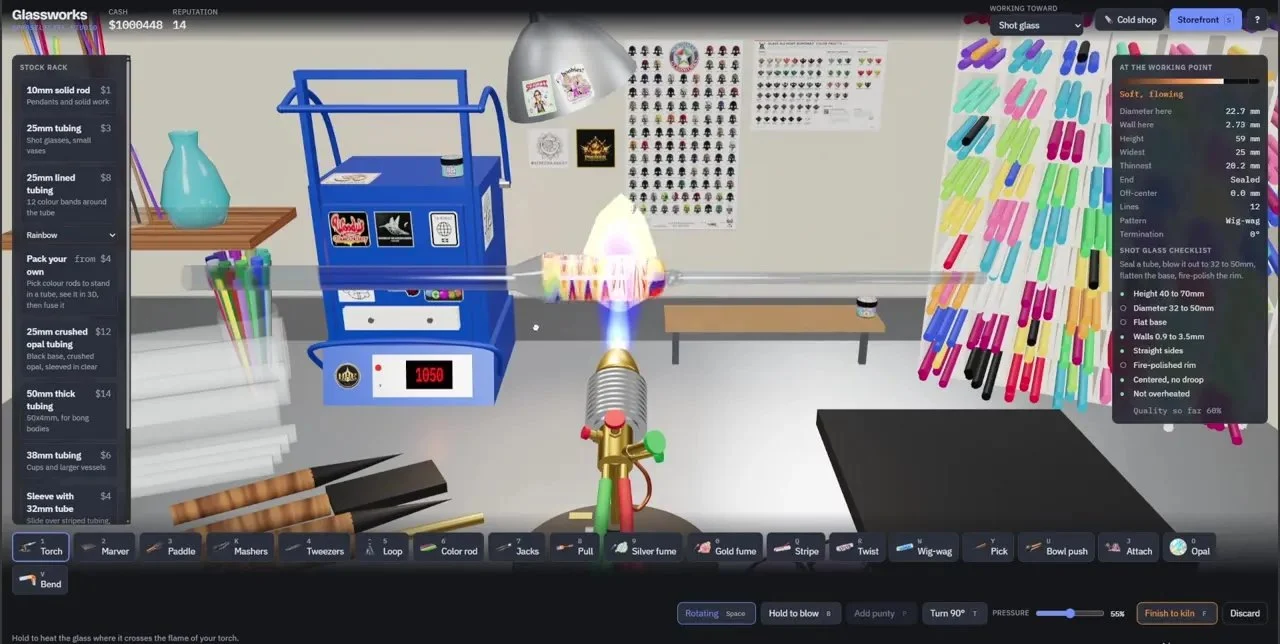
The Glassworks bench: clear glass glowing in the flame, with color rods, tubing and the kiln close by.
The history above shows up at the bench:
Snodgrass's color shift: fume a piece with silver or gold and watch it change.
Linework with Venetian roots: reticello, the crossed net pattern Venetian makers are known for, plus wig-wag and fillacello.
The finish every lampworker needs: the kiln, where pieces go when they're done.
New to the torch? The guided classes walk you through a first shot glass, a teardrop pendant and a wig-wag, one step at a time. And when you want to feel real heat, "Take a real class" lists real studios that teach it.
Light your first torch in Glassworks and make something an 18th-century enameller would recognize.
Lampworking FAQ
Why is it called lampworking?
Because the first flames came from oil or paraffin lamps. Workers pumped air into the flame with foot bellows to make it hot enough to soften glass. Gas torches replaced the lamps, but the name stuck.
Is lampworking the same as glassblowing?
Lampworking is one kind of glassblowing. Lampworkers start with solid rods and tubes heated at a torch, and they can still blow into tubing to make hollow forms. Furnace glassblowers gather molten glass from a furnace instead.
What glass do lampworkers use?
Mostly soft glass, which many bead makers use, and borosilicate, the harder glass used for lab ware, pipes and much of today's American torch art. The two expand at very different rates, so they can't be mixed in one piece.
Can I try lampworking without a torch?
Yes. A beginner class at a local studio is the best way to feel the heat. To learn the steps and the vocabulary first, Glassworks lets you practice at a virtual bench in your browser.
Keep the flame going
Make something, then show it off. Join the Glassworks Discord to share pieces and swap tips, and follow @mortonglassworks on Instagram for more glass history.